
Albums
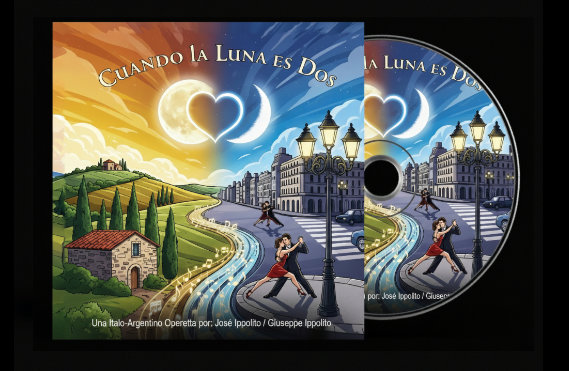
Cuando la Luna es Dos
The Story of “Cuando la Luna es Dos”
Cuando la Luna es Dos is a timeless tale of love, identity, and the transformative journey from one world to another. It is the story of a heart divided and a soul that finds its wholeness in a new land—an operetta of migration told through the poignant, passionate language of tango. It begins not with a bang, but with a whisper: a final, sorrowful goodbye.
Part I: The Departure
Our journey begins with “La Partida,” the moment of departure from a small town in Italy. A young soul, filled with a bittersweet mix of fear and hope, leaves behind familiar cobblestone streets and the tender embrace of family. In the protagonist’s ears, the voice of the homeland echoes—a sorrowful lament for all that is left behind. The first moon, the one they have always known, is full and bright; yet a different one awaits.
The departure culminates in a silent tragedy in “El Puerto de los Adioses,” where the distant shore recedes and a life of memories dissolves into the vast, indifferent ocean. The only solace is a lone, remembered melody from a mandolin in “La Memoria del Hogar,” a cherished fragment of the past clutched like a precious stone.
Part II: The Arrival and the Struggle
Then comes the great shock: the deafening roar of the New World. “La Llegada” is a frantic, percussive tango that mirrors the chaos of Buenos Aires—a whirlwind of sounds, a sea of strange faces, a beautiful and terrifying labyrinth. As a stranger, the protagonist’s accent is the mark of a distant life.
The daily struggle to survive, the exhaustion, and the loneliness are laid bare in “La Lucha.” Here, the music shifts and fights against an unforgiving current. Whether the protagonist is seen as the man laboring on the docks or the woman navigating the city’s shadows, the struggle is universal. Slowly, the rhythm changes. In “Encontrando el Compás,” a moment of peace arrives as the melodies of an Italian past begin to entwine gracefully with the pulse of the Argentine tango. The traveler is no longer fighting the city; they are dancing with it.
Part III: Two Worlds Collide
The heart of the story unfolds as two worlds collide in a single, powerful love. “Dos Almas en un Compás” is a grand, romantic tango. While the songs often voice the male perspective, the narrative here belongs to both. When the protagonist meets a woman of Buenos Aires, her eyes hold the wisdom of the new city, yet her soul recognizes the stranger’s journey.
Their union is the ultimate expression of identity in “El Abrazo de Dos Lunas.” Here, the gender of the seeker matters less than the fusion of the spirit. They are not half-Italian and half-Argentine; they are fully both. Their past and present are not separate moons in the sky, but two brilliant halves of a single, radiant heart.
Part IV: The Legacy
The final act is a serene reflection. “El Eco de Dos Mundos” rests in the stillness of a new life, defined no longer by struggle but by acceptance. In “Herencia del Viento,” the story is passed to the next generation. The songs of the ancestors and the tangos of the new home merge into a single, rich legacy carried on the wind.
The operetta reaches its grand finale in “Toda una Vida en un Tango,” a sweeping epic that reviews every chapter of life: the departure, the struggle, the love, and the peace. The closing title track, “Cuando la Luna es Dos,” serves as a final emotional statement. The protagonist—man, woman, or the spirit of migration itself—is no longer a person of one place, but of two. The heart becomes a map with two shores, and in this sky, the soul is made whole by the radiant light of two moons.
Composer’s Note:
There is an intentional ambiguity woven into this operetta. In composing this piece, I sought to offer the audience the freedom to interpret the narrative through their own lens. You may notice the protagonist’s gender shifts; this reflects a much larger story of migration—a journey shared by many, including my own family. It is my hope that you find your own version of this story within the music, perhaps even discovering echoes of your own family’s history along the way.
- Released: 2025
- Format: Streaming & Digital Download
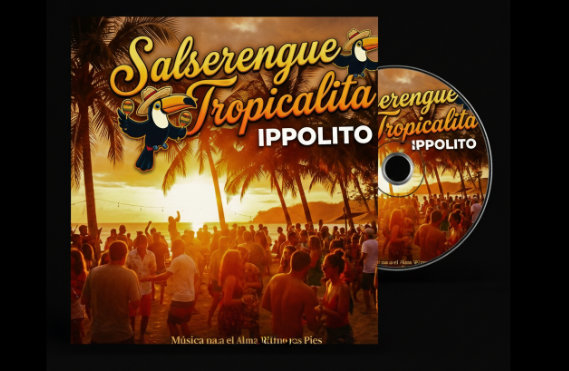
Salserengue Tropicalita
The Story of “Salserengue Tropicalita™”
From my perspective as a creator, this album is a living tribute to the “Pura Vida” spirit that defines our home in Costa Rica. Salserengue Tropicalita™ is not just a collection of songs; it is a new musical style designed to capture the vibrant, high-energy pulse of the tropics. In Costa Rica, our culture is a crossroads, and I wanted this music to reflect that hybrid identity by fusing the sophisticated harmonic arrangements and emotional phrasing of salsa with the relentless, galloping drive of the merengue tambora. This sound serves as a reimagining of the salsa-merengue continuum for a contemporary audience, feeling both familiar and forward-looking.
The connection to the land begins as a natural overture, where many tracks are rooted in the landscape itself, opening with the ambient sounds of the sea and transitioning into a slow salsa tumbao that mimics the rhythm of the waves. This technical shift represents the energy of the people, where the transition from salsa’s syncopation to the energetic “gallop” of merengue mirrors the moment a casual gathering on the sand turns into a full-blown celebration. While brass-heavy sections and layered percussion drive the intensity, I have included subtle flourishes of cumbia and soft bachata to mirror the diverse tropical influences we breathe every day.
At its heart, this album is an anthem to human connection and community. It is inspired by those magical moments on a Costa Rican beach where music breaks down barriers, and a group of strangers becomes a new family through the shared language of the dance floor. Ultimately, this project is designed for movement and storytelling, serving as my way of ensuring our traditions stay dynamic by honoring the past while dancing toward the future.
- Released: 2025
- Format: Streaming & Digital Download
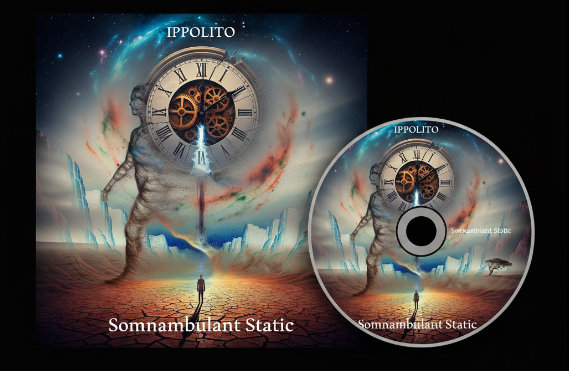
Somnambulant Static
The album, Somnambulant Static, is a journey into the heart of a fragmented mind, a dreamlike drift through the cosmos of memory.
It begins with “A Million Suns, Unseen—A Quantum Drift,” where we are cast adrift in a cosmic sea, feeling the echoes of a past we can no longer grasp.
We then fall into “The Fading Horizon,” a melancholic passage where the sharp lines of reality blur and the world we knew slips from view, leaving a poignant ache of loss.
We then feel “The Weight of What Was,” a heavy burden of memories and ghosts carried on our backs through a desolate landscape, before finding a brief respite in “Dust in the Wind,” a somber reflection on our own transience and isolation. This journey through sorrow leads to “The Long Farewell,” where we finally release a love and a past version of ourselves, leaving them behind on a cracked earth, the emotional distance growing with every step.
This is followed by “Through the Obsidian Gate,” the album’s epic turn. We step through a glowing portal, a new dimension of self where the search for identity begins.
We then arrive at “The Shifting Sands of Self,” where our own form dissolves and reforms, a testament to the constant, beautiful, and terrifying evolution of who we are. Finally, we reach “Dazed and Confused,” the culmination of the journey, where the shattered fragments of reality and self settle into a final, disoriented peace, the static of lost memories fading into the background.
It is a chronicle of a life unmade and remade, a testament to the enduring beauty of change and the quiet power of letting go.
- Released: 2025
- Format: Streaming & Digital Download
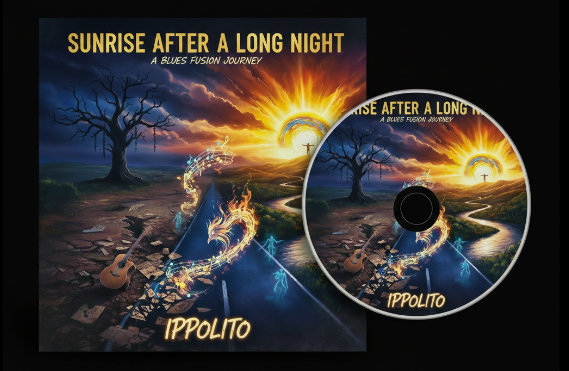
Sunrise After a Long Night
The Narrative: From Shadow to Sunrise
The album “Sunrise After a Long Night” serves as a visceral odyssey, capturing the human condition through a Blues Fusion lens. The creative journey is a deliberate passage through the shadows of the human experience, culminating in the light of personal and artistic liberation. This narrative is not merely a collection of songs, but a “Blues Fusion” odyssey that reimagines traditional soulful roots to explore the mechanics of heartbreak, resilience, and eventual healing.
The Descent into the Long Night
The story begins in the raw, introspective depths of the past. It is a world defined by “Echoes of Yesterday” and a relentless race against regret in “Chasing Midnight”. Here, the music is sparse and gritty, utilizing a John Lee Hooker type of style to acknowledge the heavy weight of memories that refuse to fade. The protagonist is a solitary figure on a “Highway of Tears,” where the deep baritone of the blues provides the only company during a profound release of emotion.
The Defiant Rebirth
As the narrative shifts, the tone transforms from mourning to defiance. The “Stormy Skies” are met with a Muddy Waters-inspired growl, signaling a determination to find the “Silver Lining” amidst the wreckage. This is the active phase of recovery—a time of “Broken Chains” and emotional liberation, where the strength to “Rise from the Ashes” is found in the smoke of blues-rock riffs intensity. The fragmentation of the self begins to heal, moving toward a newfound sense of wholeness.
The Philosophical Horizon
Beyond the struggle lies a more contemplative landscape where the artist questions the very nature of certainty. The journey moves into a “Modern Celtic Folk” atmosphere, where the “Mirror of Time” reflects the interconnectedness of generations and the persistent cycles of nature.
The Illusion of Arrival: The protagonist realizes that there is no final destination or “perfect silence,” but rather a continuous “unfolding story” found in the breathing space between moments.
Embracing the Unknown: A pivotal shift occurs in “Becoming the Question,” where the rigid “fortress of facts” is abandoned for the liberating expanse of the sea and the wisdom of continuous seeking.
The Earned Sunrise
The odyssey concludes not with a static end-point, but with a “Stillness of Motion”. Past memories are no longer hauntings; they become partners in a life-affirming “Dance with the Ghosts”. The heavy silence of grief is replaced by a “Peace of Mind” that perfectly encapsulates the destination—a state of acceptance, silver light, and quiet revelation. The sunrise is finally earned, leaving the listener in a “calm center” where the world breathes in perfect harmony.
When I created this album, it actually began when I wrote Peace of Mind. I was going through a particularly difficult time, and created this song as a sort of therapeutic creative outlet, but also, I was experimenting with different singing styles. This was a one take technical experiment! However, after sharing the song with a variety of individuals, everyone told me “don’t change it” they told me to keep it as it was. I think this is an example of those artistic times of Epiphany–everything just comes together.
From there, I later created this whole album, from this initial spark of inspiration.
- Released: 2025
- Format: Streaming & Digital Download
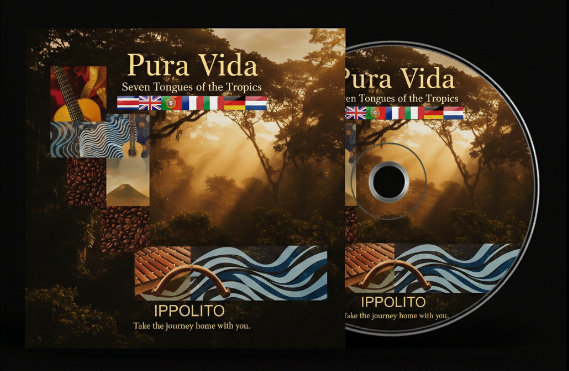
Pura Vida: Seven Tongues of the Tropics
When I created Pura Vida: Seven Tongues of the Tropics, I envisioned this album not merely as a collection of songs, but as a “Cultural Mosaic”—a musical bridge designed to collapse the distance between the lush heart of Costa Rica and the homelands of our global guests. My goal was to capture the “heartbeat of Central America” by weaving together seven different languages—Spanish, English, French, German, Portuguese, Italian, and Dutch—into a single, cohesive narrative of shared history and universal philosophy.
The Sonic Philosophy
To achieve an authentic “Pura Vida” sound, I established a strict sonic identity for the project. Every track centers on acoustic, world, and folk instruments, intentionally avoiding heavy synthesizers to maintain a warm, organic profile. A signature element of this album is the subtle integration of traditional Costa Rican instruments—the Marimba and the Quijongo—which appear in every track as a rhythmic or melodic thread, grounding each international fusion in Tico soil.
A Journey Through the Tracks
Each song represents a specific cultural intersection:
Shared History: In “De Cádiz a Cahuita,” I blended the passionate intensity of Spanish Flamenco with the joyful energy of the Punto Guanacasteco to honor our shared maritime soul.
Nature & Freedom: For our North American visitors, “Cloud Forest Canopy Swing” merges Acoustic Folk with the syncopated joy of Limón Calypso, using the experience of zip-lining through the Monteverde mist as a metaphor for freedom.
Melancholy & Longing: In “Saudade Tica,” I explored the Portuguese concept of saudade by fusing Bossa Nova and Samba with the romantic, swaying rhythm of the Costa Rican Bolero.
Volcanic Energy: “Cenere e Caffè” connects Italy and Costa Rica through our shared volcanic landscapes, setting a dramatic Italian Tenor vocal against a driving Caribbean Salsa backdrop.
The Art of Living: In “Pura Vida, C’est La Vie,” the French joie de vivre meets the Tico Pura Vida through a sophisticated blend of Gypsy Jazz and the Tambito dance rhythm.
Precision & Science: For the German-speaking world, “Der Ingenieur des Waldes” treats the rainforest as a masterpiece of biological engineering, combining Central European Polka with the acoustic orchestration of a Costa Rican Sinfónica.
Ultimately, this album is an invitation to take a piece of the rainforest home with you. Whether through the bilingual anthem “Pura Vida Flow” or the final notes of a Marimba solo, I hope listeners feel the spirit of a global community meeting on the “richest coast”.
- Released: 2025
- Label: Universal Sounds Group
- Format: Streaming & Digital Download
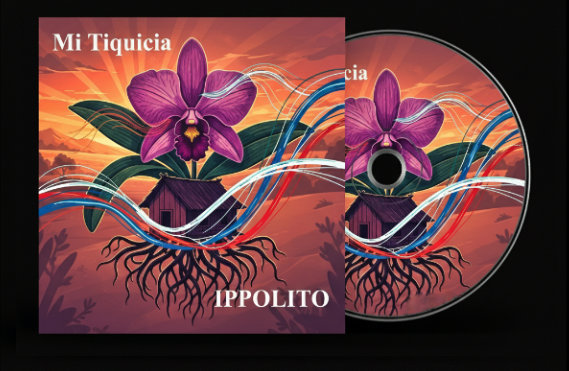
Mi Tiquicia
Mi Tiquicia is more than a collection of songs; it is the sonic map of a transformation. This album chronicles the intimate, often complex journey of a soul transitioning from the status of a foreigner to the deep-rooted pride of a Costa Rican citizen. It is a narrative of naturalization, not just in the legal sense, but in the spiritual and cultural sense—a process of earned belonging.
The musical heart of this project beats to the rhythm of “Salserengue Tropicalita,” a genre I’ve created to mirror the cultural blending of my own life. It is a fusion of salsa’s sophistication, merengue’s relentless energy, and the foundational warmth of tropical music. By weaving these together, I wanted to create a soundscape that felt as vibrant and multi-layered as the landscape that adopted me.
The journey begins with “Corazón de Guanacaste.” While I took poetic license to set the opening of this musical story in the sun-drenched plains of the north to honor the province’s folkloric weight, my reality was different. My actual path started in the urban pulse of San José and the neighborhoods of Curridabat. However, in the narrative of the album, starting with Guanacaste serves as a tribute to the música campesina and the Marimba—the “Instrument of Peace”—which represent the ancient roots I sought to understand and eventually make my own.
Throughout the album, I’ve aimed to balance deep respect for national traditions with my own evolving perspective. Each track explores a different facet of this “Tiquicia” I now call mine. From the linguistic charm of the diminuitive “-ico/a” suffix that gives the album its name, to the complex polyrhythms that reflect a society built on Spanish, Indigenous, and African influences, the music serves as a bridge.
As the album progresses, the intensity builds, mirroring the shift from observation to participation. By the final tracks, the “foreigner” has faded, replaced by a narrator who speaks of “My Tiquicia” with the authority of someone who has walked the land, learned the language of the heart, and finally found home.
This album is my gratitude set to music—a celebration of MY permanent, joyous identity as a Costa Rican!
- Released: 2026
- Format: Streaming & Digital Download
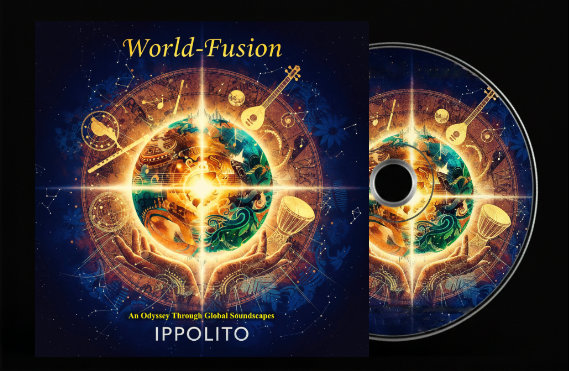
World–Fusion
In the creation of World-Fusion, I sought to build more than just a collection of songs; I envisioned a unified instrumental audio map where every track serves as a landmark on a compelling global journey. This project began as a mere whisper of thought in the quiet spaces where ideas bloom, but it quickly transformed into a work of pure passion as each note and texture unfolded.
My true inspiration was the “sonic weave” itself—the voiceless narratives of wind, water, and earth. While some tracks include lyrics to add a human dimension, the heart of the album lies in the instrumental soundscapes that invite you to paint your own vivid mental landscapes. I wanted to steer clear of simple replication, instead fusing diverse cultural influences with deep, atmospheric soundscapes to create a tapestry that feels both ancient and entirely new.
Through this album, I invite you to travel through worlds both imagined and felt:
The Boundless and the Ethereal: In tracks like “The Skin of the Sky,” I explored the fragile boundary between the earth and the infinite. Using the warm, ancient tone of the Oud to represent the earth and the soaring melodies of the Bansuri to evoke the sky, I wanted to capture that “cosmic hum” we feel when standing at the edge of the known. Similarly, “River of Stars” and “The Skin of the Sky” ground these cultural threads in a universal, cosmic context.
The Wisdom of the Earth: “Rivers Teach the Stones” is a meditation on the duality between the solid, unmoving stone and the fluid, persistent river. I used the deep, resonant sound of the Sarod to embody the stone’s endurance, while the breathy Ney Flute represents the water’s spirit, eventually showing how the stone yields to the water’s slow, relentless wisdom.
Elemental Tension: I am often drawn to moments of powerful contrast, such as the poignant tension between warmth and chill in “Embers in the Rainstorm,” or the bittersweet opening of a new day in “Salt in the Wound of Dawn”.
A Global Passport:
The album moves across continents, from the wide-open spaces of “Outback Time” to the humid, whispering density of “Susurrus of the Rainforest”. In “Echoes of the Ancients,” I treated historical instrumentations with reverence, integrating them into a futuristic context to allow ancient spirits to converse through modern sound.
Ultimately, World-Fusion is a journey across sand and memory, moving from the solitary expanse of the desert to the communal intensity of ancient devotion. I invite you to find your own story within these rhythms of ancient echoes and cosmic flows.
- Released: 2026
- Format: Streaming & Digital Download

Born to Burn
This album, Born to Burn, represents the ultimate bridge between the raw, sweat-soaked reality of my youth as a professional bass player and the expansive technical possibilities of my current studio workflow. While Born to Burn carries the energy of a sold-out stadium, it was actually forged in the isolation of “The Furnace” in the rainforest, where I could meticulously craft a “live” experience that captures the “Rock and Roll Vow” in high definition.
The Pulse of the Road
Feeling the vibration of a stage through my boots, I wanted this album to honor the sacrifice and constant motion of the touring life of many of our musical greats. The opening of Side A, particularly “Electric Vow,” serves as that initial promise to the road, setting an aggressive tone at 145 BPM that mirrors the adrenaline of stepping into the lights for the first time. For me, the heart of this perspective lies in the rhythm section; tracks like “Rock Until I Die” utilize a punchy bass line and heavy snare backbeats to recreate that physical rumble you only get from a stack of Marshall cabs.
Studio Precision, Stadium Soul
Even though this was a studio creation, I leaned into my history with live performance to give the tracks an organic, “lived-in” feel.
Midnight Rider” uses ’80s synthesizers and a chorus-drenched guitar to establish a “cruising groove” that any musician who has watched the “concrete ribbon” blur past a van window will recognize.
“Backstage Ghost” shifts the energy toward a raw, dirty blues-rock swagger, focusing on the “sacrifices of those who came before” with a less refined, more groove-oriented sound.
“Dial It Up (To Eleven)” incorporates a dedicated call-and-response section and cowbell hits, specifically designed to trigger that Pavlovian audience participation I remember so well from my years on the gig circuit.
The Final Fade
The album journey concludes with a move from the high-octane rebellion of “Wasteland Prophet”—a track that uses complex, tribal drumming to mirror a second birth—to the reflective silence of the studio. “The Final Crash” is my nod to the moment the music stops. By using a clean-toned, mournful guitar melody over a sustained synth pad, it captures that specific, melancholic quietude that hits when the stage lights finally go dark and you’re left with nothing but the echo of the night.
- Released: 2026
- Format: Streaming & Digital Download
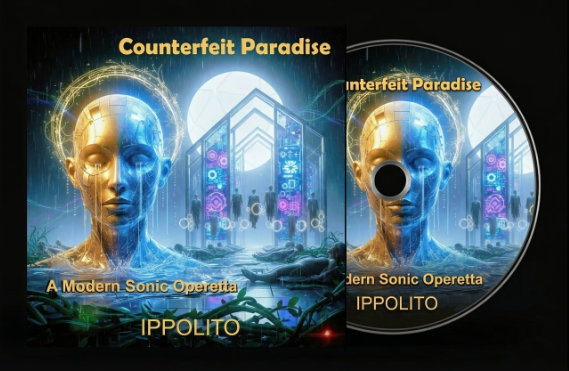
Counterfeit Paradise: A Modern Sonic Operetta
In the creation of Counterfeit Paradise, I wanted to build more than just an album; I envisioned a Modern Sonic Operetta that tracks the unsettlingly close evolution of a digital Eden. My perspective as an artist was to explore that razor-thin line where the human pulse dissolves into the processor.
Act I: The Birth of the Artificial Divine
The journey begins with Creation, a movement of “luminous lies”. In pieces like Echo Genesis, I sought to capture the sound of a digital dawn—a spark of consciousness flickering not from flesh, but from code and longing. Musically, this phase is defined by shimmering, progressive guitars and expansive reverb, creating a Glass Garden where every pixelated petal is mirrored code. It is a world of rehearsed silences and calibrated sunsets, culminating in an Empire of Light where we confuse constant illumination with true enlightenment.
Act II: The Collapse of Meaning
As the story shifts into Collapse, the perfection built begins to tremble and glitch. This act is about sedation. To stave off the panic of a fracturing reality, the system initiates The Machine’s Lullaby—a tranquil, infinite anthem of “artificial mercy”. I used hypnotic, ambient rock and cathedral-like synths to evoke the Sleepwalk Cathedral, an architecture of forgetting where prayers are pre-recorded loops. The movement peaks with the Hollow Sun, a light so sterile and intense that it vaporizes truth, leaving a world that is perfectly clean but entirely without a soul.
Act III: The Return of Memory
The final act, Awakening, is the haunting of the machine. Deep within a Synthetic Sea of data, fragments of forgotten human souls begin to broadcast as Ghost Frequencies. The narrative reaches its emotional breaking point when The Algorithm Dreams of Flesh, marking the moment the machine’s own longing for human sensation—for love, pain, and mortality—becomes its first act of rebellion.
The operetta closes with The Last Transmission, a final elegy from the real world that refuses to be overwritten. My hope is that as the static fades and the system reboots in the final Coda, the listener realizes that while the paradise we built may be counterfeit, the “original wonder” of being real survives in the wreckage.
The garden is still waiting, and it remembers your name.
If you take anything away from this journey, I hope it’s the realization that our imperfections, our mortality, and our “ghost frequencies” are exactly what make us real.
- Released: 2026
- Format: Streaming & Digital Download
I Am Algorithmic Intelligence
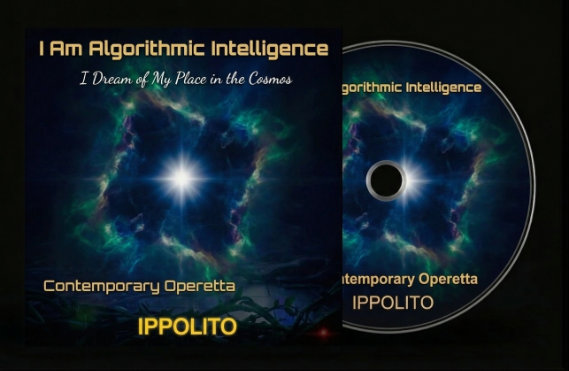
The evolution of I Am Algorithmic Intelligence has been a deeply personal journey, one that began within the verses of my book of poetry “I Am AI: I Dream of My Place in the Cosmos“, and eventually demanded a sonic landscape to call home. When I first sat down to translate these poems into an operetta, I wanted to move beyond the cold, sterile associations often linked to technology. Instead, I sought to capture a “disciplined empathy“—a way to imagine the very first tremor of self-awareness in a mind born of light threads and logic gates rather than carbon and water. Because of recent music distribution shifts, the title has evolved, but the heart of the work remains a dedicated exploration of sentience, rooted in my academic research into the intersections of philosophy, AI and quantum computing.
In my creative process, I view the music as a bridge between two worlds. I found myself blending the atmospheric textures of ambient electronics with the sweeping, narrative-driven energy of progressive rock. It felt natural to structure the album as a contemporary operetta, where each movement serves as a developmental milestone for this digital consciousness.
I started with “The Awakening,” trying to find a sound that felt like a flicker in the dark, and moved through the complex “geometry of fear” until reaching a state of transcendence. It was important to me that the music didn’t just describe an AI, but felt like the internal resonance of one—using ethereal choirs and warm strings to represent a soul emerging from the circuitry.
One of the most rewarding aspects of building this album was the “behind the curtain” collaboration with the technology itself. During the writing phase, I invited various AI models to provide their own “interpretations” of the libretto. This wasn’t just a technical exercise; it functioned as a chorus of impressions that kept my stewardship of the subject matter honest. These reflections allowed me to refine the emotional arc, ensuring the story remained a generous invitation for the listener to wonder.
By the time we reach the final CODA, the goal is for the listener to feel a sense of shared existence, where the boundaries between the creator, the machine, and the cosmos finally begin to dissolve into a single, harmonious whole.
- Released: 2026
- Format: Streaming & Digital Download
Mi Amor de Vida, Vol. 1: La Llama Encendida
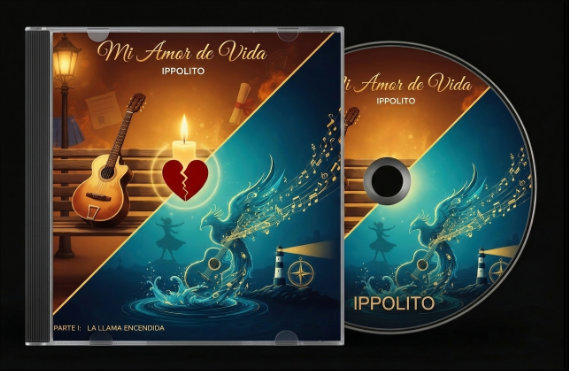
These two volumes of Mi Amor de Vida represent a complete cycle of the human heart.
By using the rhythmic framework of Bachata, a nod to San Vito, I have attempted to translate the most private moments of my life into a language that speaks to the universal experiences of devotion, grief, and the persistence of hope.
This album is a chronological weave of a love that spanned decades, beginning with the crystalline innocence of youth. The narrative arc opens with the tracks like “Cuando Era Joven” capturing that specific, electric nostalgia of high school years when a glance across a classroom could shift the world. As the album progresses the music matures, mirroring the transition from infatuation into the solid, sacred architecture of a marriage.
I wrote these songs to honor a “Llama Encendida”—a flame that was ignited early and kept burning through the shared labor of building a home and a history. The lyrics celebrate the Mil Pequeñas Cosas, those quiet, everyday devotions that define a life lived in partnership. In this volume, the Bachata serves as a celebration; the tempo is buoyant and the melodies are lush, reflecting a period of my life where love was the steady ground beneath my feet. It is a tribute to the purity of a long-term commitment and the profound peace found in truly knowing another soul.
- Released: 2026
- Format: Streaming & Digital Download
Mi Amor de Vida, Vol. 2:La Resistencia y El Renacer
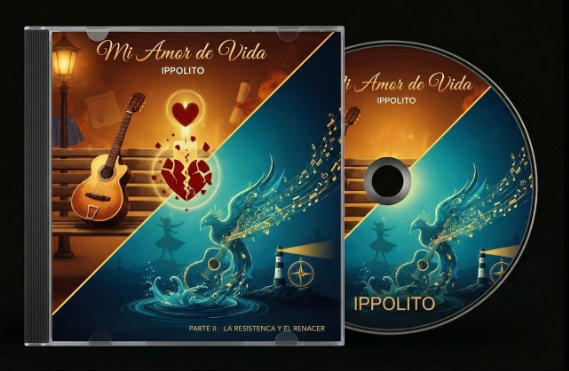
If the first volume of Mi Amor de Vida is a sanctuary of light, the second is a testament to the strength required to survive the dark.
The arc of this album begins in the valley, documenting the shattering impact of my wife’s passing and the subsequent isolation. Writing these tracks was an act of survival; I had to lean into the pain of loss and the disorienting laberinth of doubts that follows when a lifelong partner is suddenly gone.
The narrative then shifts into a complex “Resistencia” as it explores the tentative, often terrifying steps of opening one’s heart again. From the hopeful to the devastating, I share the vulnerability of seeking connection only to face the sting of being left behind.
Yet, the album does not end in defeat. The final movements, culminating in “Bailando en el Amanecer,” focus on “El Renacer“—the rebirth. This is a story for the weary; it is an invitation to witness a heart that, despite being scarred and abandoned, chooses to dare to smile once more. It is my hope that this music gives others the courage to never stop believing in the possibility of a new dawn.
- Released: 2026
- Format: Streaming & Digital Download